

Introduction
India’s global freelancing economy is booming. Developers, UI/UX designers, AI specialists and management consultants are delivering high-value work to clients across North America, Europe and Asia. However, handling international income introduces tax complexity.
For Indian independent professionals, Section 44ADA of the Income Tax Act, 1961 offers a significant tax benefit: eligible professionals can declare just 50% of their gross international revenue as taxable profit, with the remaining 50% treated as presumed business expenses under the presumptive taxation scheme.
However, as global clients increasingly prefer paying via stablecoins (USDC/USDT) or fast offshore rails, freelancers face critical compliance questions:
- How do you prove to the Income Tax Department that international incoming funds represent active business income rather than speculative crypto trading?
- How do you protect your Section 44ADA claims during a tax audit?
Here is a detailed guide on navigating Section 44ADA for foreign earnings, avoiding common audit triggers and leveraging DashX’s compliant fiat and stablecoin settlement rails.
Decoding Section 44ADA for International Service Exporters
What Is Section 44ADA?
Section 44ADA is a presumptive taxation scheme designed specifically for eligible independent professionals residing in India. Instead of tracking every individual business expense, such as internet bills, software subscriptions and laptop depreciation, the presumptive scheme determines taxable professional income based on a prescribed percentage of gross receipts.
Eligibility Criteria
To qualify for Section 44ADA, you must meet the applicable conditions, including:
- Eligible Profession: You must practice a specified profession under Section 44AA(1), which includes professions such as legal, medical, engineering, architectural, accountancy, technical consultancy, interior decoration and other notified professions.
- Residential Status: You must meet the applicable residential-status requirements. The presumptive scheme applies to eligible individuals and partnership firms, subject to the applicable exclusions.
- Gross Receipt Threshold: Your total gross professional receipts in a financial year must remain within the statutory threshold applicable for that year.
Standard Threshold: Up to ₹50 Lakhs.
Enhanced Threshold: Up to ₹75 Lakhs where the applicable condition relating to cash receipts is satisfied, including the requirement that cash receipts do not exceed the prescribed percentage of total gross receipts.
Note: International client payments received through banking channels and eligible digital payment rails can help satisfy the applicable digital-receipt condition, subject to the rules for the relevant assessment year.
The Math: How Presumptive Tax Works
Suppose you earn $50,000 USD in a financial year from international clients. At an exchange rate of 1 USD = ₹95, this converts to ₹4,750,000 INR (₹47.5 Lakhs) in total professional receipts.
- Gross Professional Receipts: ₹4,750,000
- Deemed Taxable Profit (50% under Section 44ADA): ₹4,750,000 × 50% = ₹2,375,000 (₹23.75 Lakhs)
- Presumed Expense Component: ₹2,375,000 (₹23.75 Lakhs)
Instead of calculating taxable professional profit by individually claiming every business expense, the presumptive scheme treats 50% of the eligible gross receipts as professional income.
You then apply the applicable individual income-tax slab rates and other provisions relevant to your assessment year.
Key Advantages of Section 44ADA
- Simplified Bookkeeping: The presumptive scheme can significantly reduce the need to track individual business expenses for determining professional profit.
- Simplified Tax Compliance: Eligible professionals can use the presumptive framework rather than calculating taxable professional profit from every individual expense.
- Reduced Audit Burden: Where the conditions of the presumptive scheme are satisfied, the corresponding tax-audit requirements may not apply.
The Audit Trail: Linking Digital AD Category I Bank e-FIRAs with Bank Statements
While Section 44ADA simplifies professional-income computation, it does not remove the need to substantiate the origin and nature of your income.
Why Income Tax Officers Flag Foreign Inward Inflows
When foreign remittances reach your Indian bank account, maintaining proper documentation helps establish the source and nature of those funds.
An Assessing Officer reviewing your return may scrutinize foreign inflows where the bank records, invoices, tax return and supporting documentation do not reconcile.
The Proof Engine: The AD Category I Bank e-FIRA
To support your Section 44ADA position, you should maintain documentation showing that incoming funds relate to genuine professional services and foreign exchange realization.
A standard bank statement entry showing an INR deposit may not, by itself, establish the foreign origin or underlying service. A Foreign Inward Remittance Advice (e-FIRA) issued by an Authorised Dealer (AD) Category I Bank can provide additional documentary support for an eligible foreign inward remittance.
The Audit Trail Chain
1. Client Export Invoice
              │
              ▼
2. Domestic Bank Statement
   (INR Deposit Entry)
              │
              ▼
3. AD Category I Bank e-FIRA
   (RBI Purpose Code)
By linking these documents, you establish a clear documentary trail:
- The Invoice shows the professional service rendered to the overseas client.
- The Bank Statement confirms the date and amount of the INR credit.
- The e-FIRA provides supporting documentation for the foreign inward remittance and its reported purpose.
The applicable RBI purpose code should correspond to the underlying service and transaction.
How DashX Fiat & Stablecoin Flows Deliver Audit-Ready 44ADA Documentation
DashX provides global freelancers with payment collection infrastructure combining fiat collection rails with stablecoin settlement flows. The specific tax and regulatory treatment depends on the applicable transaction structure, banking arrangements and current law.
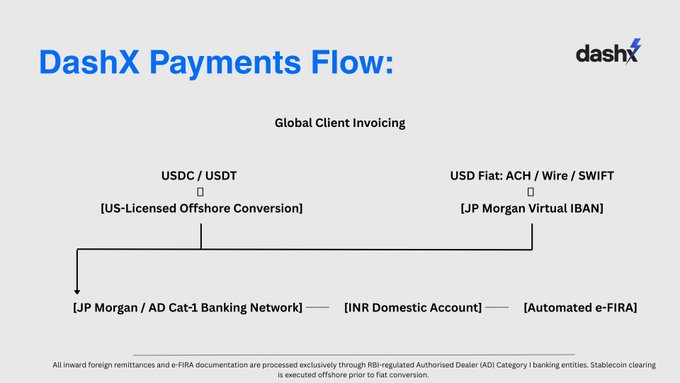
How the DashX Architecture Works
Dual Collection Channels — Fiat & Digital Assets
- Fiat Collections via Virtual IBANs: DashX provides users with virtual account details through its payment infrastructure. International clients can pay through supported local or international bank-transfer methods.
- Stablecoin Collections — USDC/USDT: Clients who prefer digital assets can pay using supported stablecoins through the available payment infrastructure.
Offshore Conversion via Licensed Entities
Where supported, stablecoin conversion into fiat is performed through applicable offshore financial infrastructure.
The exact tax and regulatory treatment depends on the transaction structure, jurisdiction and applicable Indian law.
Institutional Fiat Clearing via Banking Partners
Once funds are converted into fiat, the resulting funds can enter the applicable fiat-clearing pipeline alongside supported bank-transfer payments.
Authorised Dealer (AD) Category I banking partners handle eligible foreign inward remittances and INR settlement according to their procedures.
e-FIRA Delivery with RBI Purpose Codes
For eligible foreign inward remittances, the relevant AD Category I bank may issue a Foreign Inward Remittance Advice (e-FIRA) and report the transaction using the applicable RBI purpose classification.
The exact purpose code depends on the underlying service and transaction.
Why This Matters for Section 44ADA
Maintaining invoices, bank statements, remittance documentation, purpose-code records and e-FIRAs creates a stronger documentary trail for demonstrating that your receipts relate to professional services.
This documentation can support your Section 44ADA position, but it does not by itself guarantee a particular tax treatment or eliminate all compliance risk.
How to Avoid 4 Common Income Tax Audit Triggers
Moving offshore earnings into domestic bank accounts requires careful handling. Here are four common audit triggers for freelancers and how to avoid them.
Trigger 1: Using P2P Crypto Platforms or Personal Wallets
The Mistake: Accepting USDC/USDT into a personal wallet or crypto exchange and selling it through peer-to-peer (P2P) transfers to receive INR.
Why It Can Trigger Scrutiny: P2P deposits can make it harder to establish the commercial source and purpose of funds and may complicate reconciliation with invoices and remittance documentation.
How to Avoid It: Use a documented payment collection route appropriate for business receipts and retain invoices, transaction records, conversion records and applicable remittance documentation.
Trigger 2: Discrepancies Between AIS/TIS and Filed Returns
The Mistake: Failing to reconcile your Annual Information Statement (AIS) and Tax Information Summary (TIS) with your declared ITR receipts.
Why It Triggers Scrutiny: Differences between reported financial information and the income declared in your return can lead to questions or notices.
How to Avoid It: Download your annual transaction ledger and e-FIRAs before filing your tax return and reconcile the relevant figures with your invoices, bank statements and ITR.
Trigger 3: Crossing the GST Registration Threshold Without Reviewing Your Obligations
The Mistake: Assuming that because Section 44ADA covers income tax, GST registration is automatically unnecessary.
Why It Triggers Scrutiny: Income-tax presumptive taxation and GST are separate compliance regimes. Exporters must independently determine whether GST registration and export documentation requirements apply to them.
How to Avoid It: Review your aggregate turnover and export status with a qualified tax professional and, where applicable, register for GST and use the appropriate export mechanism such as an LUT.
Trigger 4: Declaring Profit Below 50% Without Meeting the Applicable Audit Requirements
The Mistake: Filing under Section 44ADA but declaring net profit below the presumptive percentage without considering the applicable books-of-account and audit provisions.
Why It Triggers Scrutiny: Choosing a lower profit declaration can trigger additional compliance requirements under the applicable provisions of the Income Tax Act.
How to Avoid It: If you choose Section 44ADA, understand the applicable presumptive and audit rules before filing. If you intend to declare a lower profit, consult a CA regarding the books and audit requirements that may apply.
Checklist for Global Freelancers
To maximize your take-home earnings while remaining fully tax compliant:
- Verify 44ADA Eligibility: Ensure your profession qualifies under the applicable provisions and that your receipts remain within the relevant statutory threshold.
- Route Payments Through Documented Business Rails: Allow overseas clients to pay through supported fiat or stablecoin collection infrastructure and retain the complete transaction trail.
- Collect e-FIRAs for Eligible Remittances: Download and retain applicable AD Category I e-FIRAs and supporting payment records in your compliance folder.
- Review GST Obligations: Determine whether GST registration and an LUT are applicable based on your aggregate turnover and export structure.
- File Your ITR Accurately: Reconcile invoices, bank statements, e-FIRAs and other transaction records before declaring professional receipts under Section 44ADA.
Ready to Streamline Your Global Freelance Income?
Sign up for DashX to explore stablecoin and fiat payment collection infrastructure, supported remittance documentation and streamlined cross-border payment operations.
Disclaimer
DashX provides payment and stablecoin routing infrastructure. The tax, GST, foreign-exchange and e-FIRA treatment of a transaction depends on the applicable structure, documentation, banking arrangements and current laws and regulations.
Consult a qualified Chartered Accountant or tax professional for advice specific to your circumstances.