Receiving USDT or USDC for Overseas Services as an Indian Freelancer, Agency Owner or Tech Founder
Overseas clients are offering to pay you in USDT or USDC for your services but as an Indian freelancer, agency owner or tech founder you are hesitant: Will receiving stablecoins trigger harsh crypto tax rates? How do you get an official AD-Category 1 eFIRA to prove export of services and file 0% GST under an LUT?
Here is the truth: receiving USDT or USDC for your services is legally classified as an Export of Services. When processed through compliant banking infrastructure these payments are taxed like any traditional bank wire allowing you to pay standard business taxes and claim GST benefits.
The Misconception: Service Earnings vs Asset Speculation
A widespread misconception among Indian service exporters is that receiving stablecoins instantly subjects your income to non deductible digital asset tax regimes or regulatory ambiguity.
Under Indian tax and foreign exchange law, tax liability is determined by the underlying nature of the transaction:
- Trading/Speculation: Buying, holding or trading cryptocurrencies on exchanges as speculative digital assets.
- Export of Services: Providing software engineering, UI/UX design, digital marketing or business consulting to a client located outside India.
When you deliver a service to an overseas client the money earned is active business revenue from international trade. The currency or token used by the buyer on the offshore end does not change the fact that your work constitutes a service export.
How Stablecoin Service Revenue Is Taxed in India
When you receive stablecoin payments through a compliant processing structure your income qualifies for standard business tax treatment:
1. Income Tax: Standard Business Income (PGBP)
Your earnings are treated as standard income under Profits and Gains of Business or Profession (PGBP):
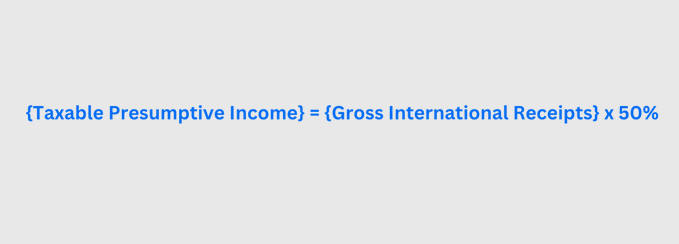
- For Freelancers & Solopreneurs (Section 44ADA): If your total gross receipts are up to ₹50 Lakhs (or ₹75 Lakhs where digital receipts exceed 95%), you can utilize the Presumptive Taxation Scheme under Section 44ADA of the Income Tax Act. This allows you to declare 50% of your total gross receipts as taxable profit, deducting the remaining 50% as presumed business expenses without maintaining detailed books of accounts.
- For Companies & Agencies: Revenues are recorded as top-line business turnover, allowing you to deduct all operational expenses (salaries, software subscriptions, office rent, hardware) before calculating net corporate income tax.
2. Goods & Services Tax (GST): Zero-Rated Supply
Under Section 16 of the Integrated Goods and Services Tax (IGST) Act, 2017, the export of services is categorized as a zero-rated supply.
-
Export Under LUT (Form GST RFD-11): By filing an annual Letter of Undertaking (LUT) on the GST portal, you can issue invoices to international clients with 0% GST.
-
Input Tax Credit (ITC) Refunds: Because your exports are zero-rated, you retain the legal right to claim full refunds on the domestic Input Tax Credit (ITC) paid for business overheads (e.g., 18% GST paid on laptops, office rent, or cloud infrastructure) via Form GST RFD-01.
The Compliance Gap of Direct Wallet-to-Wallet Transfers
If stablecoin earnings qualify as service exports, what causes compliance issues when receiving crypto directly into a personal wallet?
The issue lies in banking realization proof. For tax and GST authorities to treat incoming funds as an export of services, two conditions must be met:
- The payment must represent foreign exchange realized through official banking channels.
- An Authorised Dealer (AD) Category I Bank must issue a Foreign Inward Remittance Advice (e-FIRA) tagged with the appropriate Reserve Bank of India (RBI) Purpose Code.
Direct Wallet Transfer
[Client Wallet] ---> (USDC/USDT) ---> [Personal Indian Wallet]

Result:
> NO Banking Channel
> NO e-FIRA
> Cannot Prove Zero-Rated Export
> Compliance Exposure
When an overseas client transfers USDC or USDT directly into your self-custody wallet or crypto exchange account, no AD Category I bank is involved in the transfer. As a result no e-FIRA is generated. During a GST or Income Tax assessment, tax officers cannot verify that the transaction represents legitimate foreign exchange realization, leaving your business exposed to tax penalties or loss of ITC refunds.
How DashX Bridges Stablecoins to AD Category 1 Banking
@DashXHQ eliminates the compliance gap by pairing public blockchain rails with traditional domestic banking infrastructure.
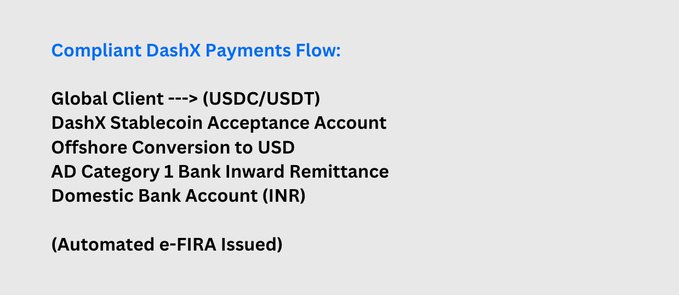
Compliant Flow for USDT/USDC Payments in India
- Offshore Acceptance: Your overseas client pays your invoice using USDC or USDT over low-cost blockchain networks, enabling instant settlement regardless of global banking hours.
- Offshore Liquidation: The stablecoins remain strictly outside Indian jurisdiction. DashX's banking partners liquidate the digital tokens into USD offshore, converting the asset into traditional fiat currency before it enters the domestic banking system.
- Inward Remittance via AD Category I Bank: The funds enter India through an Authorised Dealer (AD) Category I partner bank and land directly in your Indian bank account as Indian Rupees (INR).
- Automated Purpose-Coded e-FIRA: The transaction is reported to the RBI under the Foreign Exchange Transactions Electronic Reporting System (FETERS) with the correct purpose code (e.g., P0802 for software implementation/consultancy or P0807 for off-site software development). An official digital e-FIRA is generated automatically in your dashboard at no extra cost.
Why Modern Service Exporters & Freelancers Are Upgrading
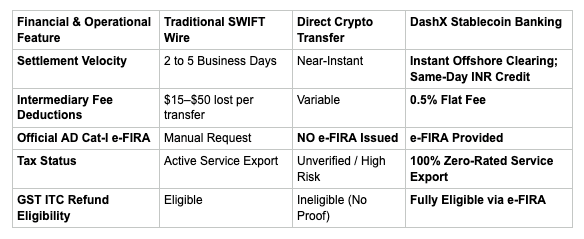
By separating offshore stablecoin collection from domestic fiat settlement, DashX provides several key advantages:
Summary Checklist for Indian Exporters
If you are receiving international payments for freelancing, agency work, or SaaS subscriptions:
- File an annual Letter of Undertaking (Form GST RFD-11) on the GST portal to ensure your export invoices carry 0% GST legally.
- Use DashX for client payments to allow clients to pay via stablecoins (USDC/USDT) or Fiat, while ensuring funds land in your Indian bank account as INR with an official AD Category I bank e-FIRA.
- Maintain an audit-ready export ledger linking every client invoice to its corresponding e-FIRA and bank deposit entry for seamless tax return filing.
Ready to Streamline Your International Payments?
Get paid in USDC/USDT or any foreign currency like USD/EUR/AED/... from anywhere in the world, settle directly in INR and get compliance ready eFIRAs with DashX.