Section 44ADA is a tax provision that simplifies filing for hundreds of thousands of Indian freelancers. Yet most don't understand how it works or whether they qualify.
Let's demystify it.
What is Section 44ADA, really?
Section 44ADA is a presumptive taxation scheme in the Indian Income Tax Act, 1961. In plain language: it allows eligible independent professionals to declare only 50% of their gross receipts as taxable income, while assuming the remaining 50% was consumed as business expenses.
Normally, if you earn ₹100, you pay tax on ₹100 minus the expenses you can prove. Under Section 44ADA, if you earn ₹100, you pay tax on ₹50. The other ₹50 is deemed to be expenses you don't need to prove.
This is not tax evasion. This is a legal government scheme designed to simplify taxation for small professionals.
How does Section 44ADA work?
Let's say you're a freelance software developer. In the financial year, you earn $50,000 USD from international clients.
At an illustrative exchange rate of 1 USD = 90 INR, this converts to:
$50,000 × 90 = ₹45,00,000 (₹45 lakh)
This is your gross professional receipts.
What happens without Section 44ADA?
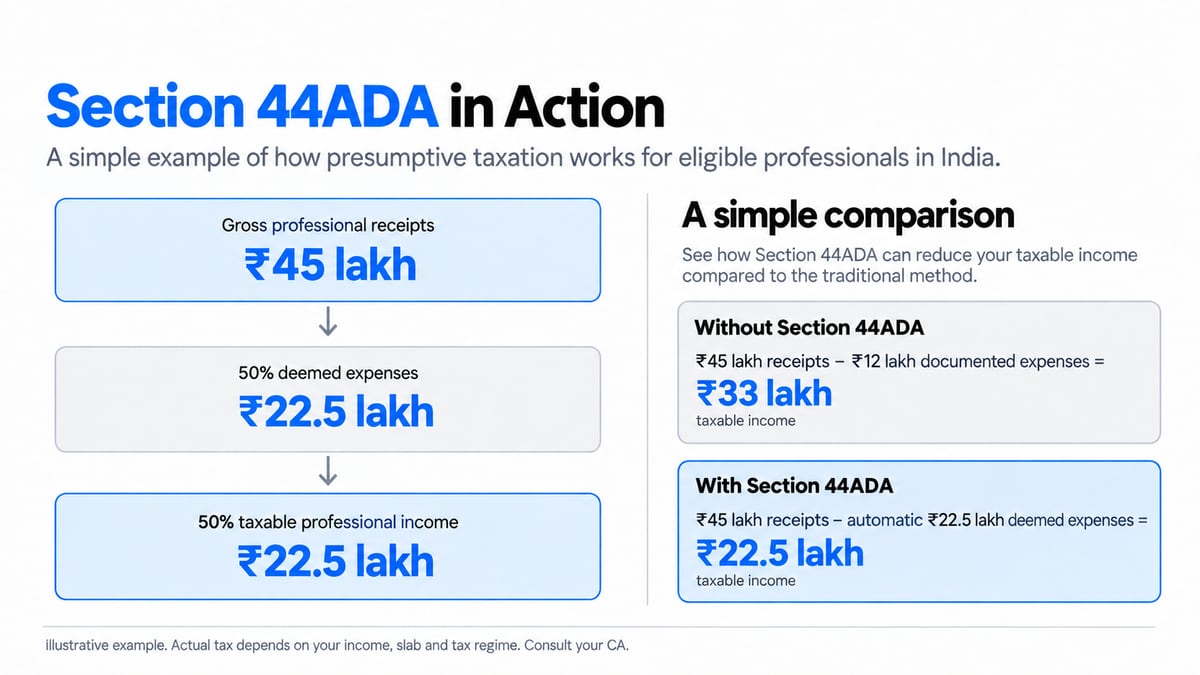
- Gross receipts: ₹45 lakh
- You must maintain books and prove every rupee of expenses (internet bills, software subscriptions, laptop depreciation, etc.)
- Let's say you prove ₹12 lakh in expenses
- Taxable income: ₹45 lakh minus ₹12 lakh = ₹33 lakh
What happens with Section 44ADA?
- Gross receipts: ₹45 lakh
- Deemed expenses: 50% × ₹45 lakh = ₹22.5 lakh (automatic, no receipts needed)
- Taxable income: ₹22.5 lakh
You pay tax on ₹22.5 lakh instead of ₹33 lakh, at your slab rate, and you never had to file a single receipt. Whether 44ADA is better for you depends on your actual expenses, your slab and your tax regime, which is a question for your CA with your numbers. For most service freelancers whose real expenses are well below 50% of receipts, it usually is.
Who qualifies for Section 44ADA?
You must meet three conditions.
Which professions are eligible?
Your work must fall under a profession specified in Section 44AA(1). These include:
- Legal
- Medical
- Engineering
- Architectural
- Accountancy
- Technical consultancy
- Interior decoration
- Other professions notified by the CBDT, which include information technology, film artists, company secretaries and authorised representatives
Most freelance software, design and consulting work qualifies as technical consultancy or IT. If you are unsure whether your specific work counts, ask your CA, because eligibility turns on the nature of the service, not your job title.
Does residency status matter?
You must be a resident individual or a partnership firm (not an LLP). If you're working from India, you likely qualify.
Non-Resident Indians (NRIs) typically don't qualify. This scheme is designed for India-based professionals.
What is the Section 44ADA gross receipt threshold?
Your total professional receipts in the financial year must be within these limits:
| Condition | Maximum gross receipts |
|---|---|
| Standard threshold | ₹50 lakh |
| At least 95% received through banking channels, not cash | ₹75 lakh |
For most freelancers earning international payments through banks or licensed payment platforms, the ₹75 lakh threshold applies, because those payments arrive through banking channels and automatically satisfy the 95% requirement.
How does the ₹50 lakh vs ₹75 lakh threshold work?
If you earn $65,000 USD (approximately ₹58 lakh at 90 INR per USD), you would fall outside the ₹50 lakh limit.
However, because 100% of your income came through banking channels, you qualify for the ₹75 lakh limit. You still get the 50% presumption.
This is a real advantage for global freelancers, and it is one more reason how you get paid matters. Cash and informal channels don't just create documentation problems, they can push you out of the enhanced limit.
Section 44ADA vs Section 44AB: what's the difference?
These two sections are often confused.
Section 44AB defines who must get a tax audit. For professionals, that is normally when gross receipts exceed ₹50 lakh in a financial year (the ₹1 crore figure you may have seen applies to businesses, not professions).
Section 44ADA is the shortcut. If you are within the 44ADA limits and declare at least 50% of your receipts as income, you are not required to get your accounts audited. You can file your ITR with your CA without an audit report, or on your own if you are comfortable.
For most freelancers, that is a meaningful saving in CA fees and time every year.
Does Section 44ADA require bookkeeping?
Normally, you must maintain detailed books of accounts. Every expense needs a receipt. Every transaction needs to be recorded. It's tedious.
Under Section 44ADA, you are exempt from maintaining elaborate books. You only need to prove your gross receipts, which your bank statements and FIRAs do. The tax department assumes you spent 50% on running your business. You don't need to justify it.
Here's the catch: you cannot declare profit below 50% and still use Section 44ADA. The scheme assumes your net profit is at least 50% of gross receipts.
Can you declare less than 50% profit?
Not under 44ADA. If you want to claim expenses higher than 50%, you must:
- Maintain detailed books of accounts (Section 44AA).
- Get a tax audit (Section 44AB).
- File the audit report with your ITR.
For most freelancers, accepting the 50% presumption is worth it. For a few with unusually high expenses, the audit route is worth it. That is a call to make with your CA.
When does Section 44ADA not apply?
You earn ₹80 lakh from freelancing. This exceeds the ₹75 lakh threshold. You cannot use Section 44ADA.
You file under normal provisions, with books of accounts and a tax audit. For many freelancers at this level, this is when a conversation about the right business structure starts, but that is a separate tax planning discussion for your CA.
What are the key benefits of Section 44ADA?
- Simpler filing (ITR-4 Sugam)
- No bookkeeping required (bank statements and FIRAs are enough)
- No tax audit within the limits
- Presumed expenses (50% is automatic)
- Lower compliance cost every year
What are the key limitations?
- Threshold cap (₹75 lakh maximum with the digital receipts condition)
- Cannot claim expenses above 50% without books and an audit
- Not applicable to trading, commission or agency income (only specified professions)
- Scrutiny is still possible (if the numbers look inconsistent, good documentation is still the answer)
- GST still applies (Section 44ADA covers income tax, not GST)
Is Section 44ADA useful for Indian freelancers?
If you are a resident freelancer in an eligible profession earning up to ₹75 lakh through banking channels, Section 44ADA is likely the simplest way to file.
File under Section 44ADA using ITR-4 (Sugam), keep your invoices, bank statements and FIRA documents organised, and your CA has everything they need.
How does DashX simplify Section 44ADA documentation?
The one thing Section 44ADA still requires you to prove is your gross receipts. Without proper documentation, that is where questions start.
What documentation does DashX provide your CA?
- FIRA for every payment, issued through our AD Category I bank partners (JP Morgan and HDFC) via PA-CB licensed partners
- The correct RBI purpose code (P0802, P1006, etc.) assigned automatically based on your service type, so the FIRA says what your invoice says
- Every payment landing in your own Indian bank account through banking channels, which is what the ₹75 lakh threshold counts
DashX does not determine 44ADA eligibility or file taxes. We make sure the paperwork exists. Your CA makes the call.
Start with DashX and get FIRA with the right purpose code on every payment.